Session 6. Parliament: the Commons and the Lords
Key question: How does a bill become a law in Westminster?
What do you remember from session 5? Answer alone in five minutes, then check.
1. What are Bagehot's three rights of the sovereign?
2. When was Royal Assent last refused?
3. Who writes the King's Speech?
Show the recap answers
- To be consulted, to encourage, to warn.
- In 1708, by Queen Anne.
- The Government.
Key words first
- constituency: the area that elects one MP
- first past the post: the voting system where the candidate with the most votes wins
- bill / Act: a proposed law / a law that has been passed
- reading: a stage of debate on a bill
- hereditary peer: a lord whose title passes from parent to child
- to delay: to make later
Aims
- Describe the two Houses of Parliament
- Follow the real path of a bill, from 2024 to 2026
- Use the passive and sequence words: first, then, finally
To explain step by step how a bill becomes a law, and tell the story of one real Act, we need the present passive for a process, the past passive for one real case, and ordering words (first, then, after that, finally).
Documents
Document A. Two Houses (written for this sequence)
House of Commons: 650 MPs, elected.
House of Lords: members appointed, not elected.
The Lords can delay a law, but they cannot block it for ever.
Read the original text
The House of Commons has 650 MPs. Each MP is elected in one constituency, by first past the post: the candidate with the most votes wins. The Speaker, Sir Lindsay Hoyle, chairs the debates and keeps order. The House of Lords is not elected: most of its members are appointed for life, and 26 are bishops of the Church of England. The Lords examine and improve bills, but under the Parliament Acts of 1911 and 1949 they can only delay most bills for about a year, and money bills for one month.
Source: UK Parliament, The Speaker of the House of Commons · UK Parliament, The Parliament Acts
Document B. A real bill: the House of Lords (Hereditary Peers) Act 2026
2024: the bill starts in the Commons.
2025: the Lords study it.
March 2026: Royal Assent. It is now an Act.
Now, nobody sits in the Lords because of their family.
Read the original text
Introduced in the House of Commons on 5 September 2024. Second reading in the Commons on 15 October 2024. Sent to the Lords in November 2024. Lords third reading on 21 July 2025. Final agreement between the two Houses in March 2026. Royal Assent on 18 March 2026.
The Act “remove[s] the remaining connection between hereditary peerage and membership of the House of Lords”: since the end of April 2026, no one sits in the Lords because of a title inherited from their family.
Source: legislation.gov.uk, House of Lords (Hereditary Peers) Act 2026 · UK Parliament, House of Lords (Hereditary Peers) Act 2026: stages
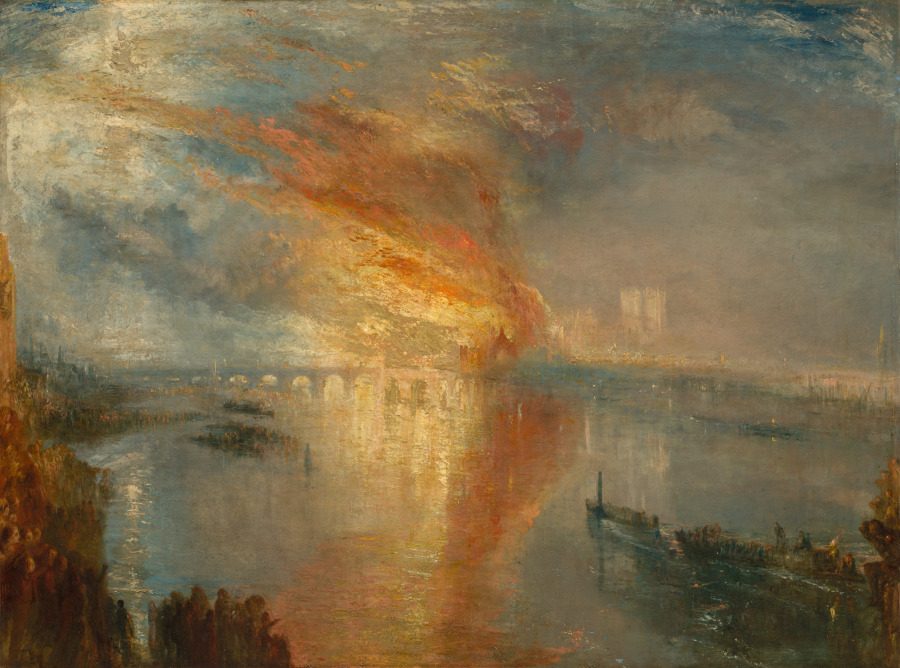
Look: On 16 October 1834, a fire destroyed most of the old Palace of Westminster; Turner watched it. The building we see today was rebuilt after this fire. In two sentences: what does the fire destroy, and what survives?
Words in action
EntryComplete with: constituency, bill, Act, reading, hereditary peer.
- A ______ is a proposed law.
- Once it has received Royal Assent, it becomes an ______.
- Each MP represents one ______.
- A second ______ is a debate on the main ideas of a bill.
- A ______ inherited his title from his family.
Show the answers
1. bill. 2. Act. 3. constituency. 4. reading. 5. hereditary peer.
To say it: Present passive and past passive
Always the same: is + past participle.
One date in the past: was + past participle.
EntryComplete with the present passive.
- First, the bill (introduce) in the Commons.
- Then, it (debate) at second reading.
- Finally, it (give) Royal Assent.
Show the answers
1. is introduced. 2. is debated. 3. is given.
Activities
- Document A: complete the identity cards of the two Houses (members, elected or not, role).
- Document B: put the stages of the bill in order on a timeline.
- Simulation: the class is Parliament. Group 1 is the Commons, group 2 the Lords, one student is the King. Pass a class bill (for example: a longer lunch break) in three steps. Language: During the simulation, the Speaker announces each step in the passive: The bill is introduced. The bill is sent to the Lords.
- Summary: the Commons decide, the Lords revise and delay, the King signs as a formality.
Sentence starters
- First, the bill is ...
- Then, it is sent to ...
- Finally, it receives ...
- The Commons are elected, whereas the Lords ...
Exercise: The path of a bill
Put the stages in the right order.
- Royal Assent
- second reading in the Commons
- the bill goes to the Lords
- introduction (first reading) in the Commons
- the two Houses agree on the final text
- committee stage and third reading in the Commons
Show answers
4, 2, 6, 3, 5, 1: introduction, second reading, committee and third reading, the Lords, final agreement, Royal Assent.
Figures of speech in the documents
“first past the post” (Document A)
first past the post = like a horse race: only the first one wins.
EntryWhich sport does first past the post come from?
Show the answers
Horse racing.
Expression task
Written, after the simulation (activity 3): the Clerk of the class Parliament writes the report of the day.
EntryFour sentences in the present passive, with first, then, after that, finally.
Tools to use:
- is introduced, was sent
- first, then, after that, finally
- bill, Act, reading, Royal Assent
Sentence starters:
- First, the bill is ...
- Then, it is ...
- Today, our bill was ...
- Finally, ...
Show a model answer
First, a bill is introduced in the Commons. Then, it is debated and voted on. After that, it is sent to the Lords. Today, our bill on a longer lunch break was introduced by group 1 and was passed by the Commons. It was delayed by the Lords, but finally it was given Royal Assent by the King, whereas the real Hereditary Peers Act needed eighteen months.
Going further (optional)
Should the House of Lords be elected? Using Document B, write 150 words weighing up the arguments for and against an appointed chamber.
Lesson plan for the teacher (55 minutes)
| 5 min | Marked recap |
| 5 min | Painting as a landmark: the fire of 1834 |
| 10 min | Document A: identity cards |
| 10 min | Document B: timeline |
| 20 min | Simulation |
| 5 min | Homework |
Draw or write the path of a bill in six steps, in English, with one sentence for each step.
Help: use the key words and the sentence starters above. Write one idea per line.
Write it in your planner before the bell. It is also posted on the school platform.
Show a model answer
Model answer: 1. A minister introduces the bill in the Commons. 2. MPs debate its main ideas at second reading. 3. A committee studies it line by line, then MPs vote at third reading. 4. The Lords do the same work. 5. The two Houses agree on the final text. 6. The King gives Royal Assent and the bill becomes an Act.