Session 2. Runnymede, 15 June 1215: the barons against King John
Key question: Why did a king accept to put limits on his own power?
What do you remember from session 1? Answer alone in five minutes, then check.
1. Who is the Head of State in the UK?
2. When does the Prime Minister answer MPs' questions?
3. Complete: the King can advise and ... his ministers.
Show the recap answers
- The King, Charles III.
- Every Wednesday at 12 midday, at Prime Minister's Questions.
- warn
Aims
- Tell the story of 1215 in the past simple
- Read two clauses of Magna Carta and rewrite them in today's English
- Understand that a charter can limit a king
To tell the story of 1215 in the right order, we need the past simple (regular and irregular verbs) and time connectors (in 1204, in May 1215, a few weeks later, finally).
Documents
Document A. The story in brief (written for this sequence)
King John ruled England from 1199 to 1216. In 1204 he lost Normandy to the King of France, and to pay for his wars he demanded more and more money from his barons. In May 1215, rebel barons took control of London. The King agreed to meet them at Runnymede, a meadow by the Thames near Windsor. There, on 15 June 1215, he set his seal on a charter that listed what the king could and could not do. A few weeks later, Pope Innocent III declared the charter void, and war started again. John died in October 1216, but the charter survived: it was reissued in 1216, 1217 and 1225. The name Magna Carta, Latin for great charter, was first used in 1217.
Source: UK Parliament, How did Magna Carta come about? · The National Archives, Magna Carta 1215 (education resource) · UK Parliament, The contents of Magna Carta
Document B. Two clauses that are still law (Magna Carta, 1297 version)
“No Freeman shall be taken or imprisoned, or be disseised of his Freehold, or Liberties, [...] or be outlawed, or exiled, or any other wise destroyed; nor will We not pass upon him, nor condemn him, but by lawful judgment of his Peers, or by the Law of the Land. We will sell to no man, we will not deny or defer to any man either Justice or Right.”
These lines come from clauses 39 and 40 of the charter of 1215. They are still part of the law in England today.
Source: legislation.gov.uk, Magna Carta (1297), chapter XXIX
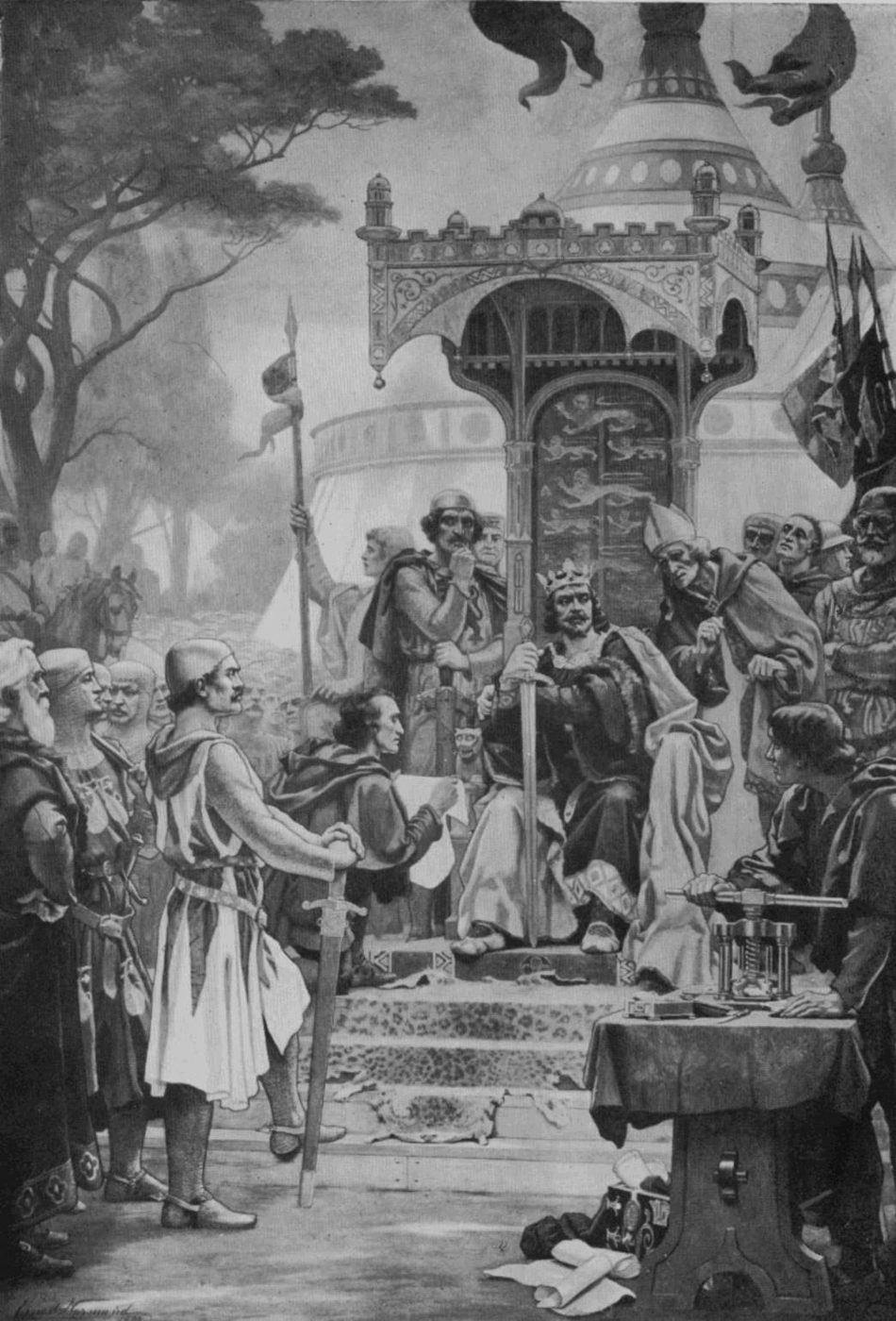
Look: Look at the man on the right: what machine is he using? Kings did not sign Magna Carta, they sealed it. What does the painter want us to remember?
Key words
| Word | Meaning |
|---|---|
| baron | a powerful lord who held land from the king |
| charter | an official document that gives or protects rights |
| to seal | to close or approve a document with a wax seal |
| imprisoned | put in prison |
| the law of the land | the normal law, the same for everyone |
| to delay | to make something happen later |
Words in action
EntryComplete with: barons, charter, seal, imprisoned, delay.
- The ______ rebelled against King John.
- A ______ is an official document that protects rights.
- Kings did not sign: they used a wax ______.
- Nobody can be ______ without a lawful judgment.
- The King cannot ______ justice.
Show the answers
1. barons. 2. charter. 3. seal. 4. imprisoned. 5. delay.
CoreWord families. Give the noun: to imprison, to rebel, to judge, to delay.
Show the answers
imprisonment, rebellion (a rebel), judgment, delay.
StretchExplain the difference between to sign and to seal, using Normand's painting.
Show the answers
To sign is to write your name. To seal is to press a wax seal on a document. In the painting, a man works a seal press: King John sealed Magna Carta, he did not sign it.
To say it: Past simple and time connectors
We use the past simple for finished actions at a known date: In 1204, John lost Normandy.
Regular verbs: -ed (demanded, agreed). Irregular verbs: lose / lost, take / took, set / set.
Negative: did not + verb. King John did not sign the charter.
Time connectors put the story in order: in 1199, in May 1215, on 15 June, a few weeks later, then, finally.
Careful: with a date, never the present perfect (In 1215 he has sealed).
EntryGive the past simple.
- lose
- take
- agree
- die
Show the answers
1. lost. 2. took. 3. agreed. 4. died.
CorePut the events in order and write a four-sentence story, each sentence starting with a time connector.
- the barons took London
- John lost Normandy
- the Pope declared the charter void
- John sealed the charter at Runnymede
Show the answers
In 1204, John lost Normandy. In May 1215, the barons took London. On 15 June 1215, John sealed the charter at Runnymede. A few weeks later, the Pope declared the charter void.
StretchCorrect the three mistakes.
- In 1215, King John has sealed the charter.
- He didn't signed it.
- The barons taked London.
Show the answers
1. In 1215, King John sealed the charter. 2. He didn't sign it. 3. The barons took London.
Activities
- Read Document A and build a five-date timeline: 1199, 1204, May 1215, 15 June 1215, 1216. Language: Write one sentence in the past simple for each date of the timeline.
- Read Document B with the glossary. Rewrite each part in today's English, in groups of three.
- Role play in pairs: King John and a baron at Runnymede. B1: use the dialogue frame. B2: improvise. C1: a one-minute speech in the baron's voice.
- Summary: in 1215, for the first time, a written text said that the king had to respect the law too.
Exercise: Past simple and passive
Put the verb in the right form.
- King John (lose) Normandy in 1204.
- The barons (take) control of London in May 1215.
- The charter (seal) at Runnymede on 15 June 1215.
- The charter (declare) void by the Pope a few weeks later.
- Magna Carta (reissue) in 1216, 1217 and 1225.
Show answers
1. lost. 2. took. 3. was sealed. 4. was declared. 5. was reissued.
Figures of speech in the documents
“No Freeman shall be taken or imprisoned, or be disseised [...], or be outlawed, or exiled, or any other wise destroyed” (Document B)
The text piles up punishments and repeats or again and again. This accumulation, linked by a repeated conjunction (polysyndeton), closes every door: no punishment is forgotten.
EntryHow many punishments can you count in the quotation?
Show the answers
Six: taken, imprisoned, disseised (land taken away), outlawed, exiled, destroyed.
CoreWhy does the text repeat or so many times?
Show the answers
To list every possible punishment and leave no gap: the King cannot find another way to punish a Freeman (a man who was not a serf) without a trial.
StretchWrite one sentence in the barons' voice with a repeated or.
Show the answers
For example: We will not pay, or obey, or fight for you, or bow to you, until you respect the law.
Expression task
Oral, in pairs: the meeting at Runnymede (activity 3). The baron reminds the King what he did; the King answers.
EntryFour lines from the frame, with two verbs in the past simple.
CoreEight lines. Use four verbs in the past simple, two time connectors and one modal (you cannot ...).
StretchA one-minute speech in the baron's voice, with one accumulation linked by or.
Tools to use:
- past simple: lost, took, demanded
- in 1204, last year, now
- you cannot ...
Show a model answer
Baron: Your Majesty, in 1204 you lost Normandy. Then you demanded more and more money from us. Last month, we took London. King: I needed that money for my wars. Baron: Now you cannot take our land, or our money, or our freedom without a judgment. Seal this charter. King: I accept, but only to stop the war.
C1 extension
UK Parliament writes that Magna Carta “was not intended to be a great charter of rights for all people”. Who was protected in 1215, and who was not? Write a nuanced paragraph using whereas and yet.
Lesson plan for the teacher (55 minutes)
| 5 min | Marked recap |
| 10 min | Document A and the timeline |
| 15 min | Document B: rewriting in today's English |
| 15 min | Role play |
| 5 min | Painting: sealing, not signing |
| 5 min | Homework |
In 80 words, explain why King John accepted to limit his own power. Use at least three verbs in the past simple.
Write it in your planner before the bell. It is also posted on the school platform.
Show a model answer
Model answer: King John accepted Magna Carta because he had no choice. He had lost Normandy, he needed money and he asked his barons for heavy payments. The barons rebelled and took London in May 1215. At Runnymede, the King sealed the charter to stop the war. He did not really want to respect it: a few weeks later, the Pope declared it void, but the charter survived after his death.